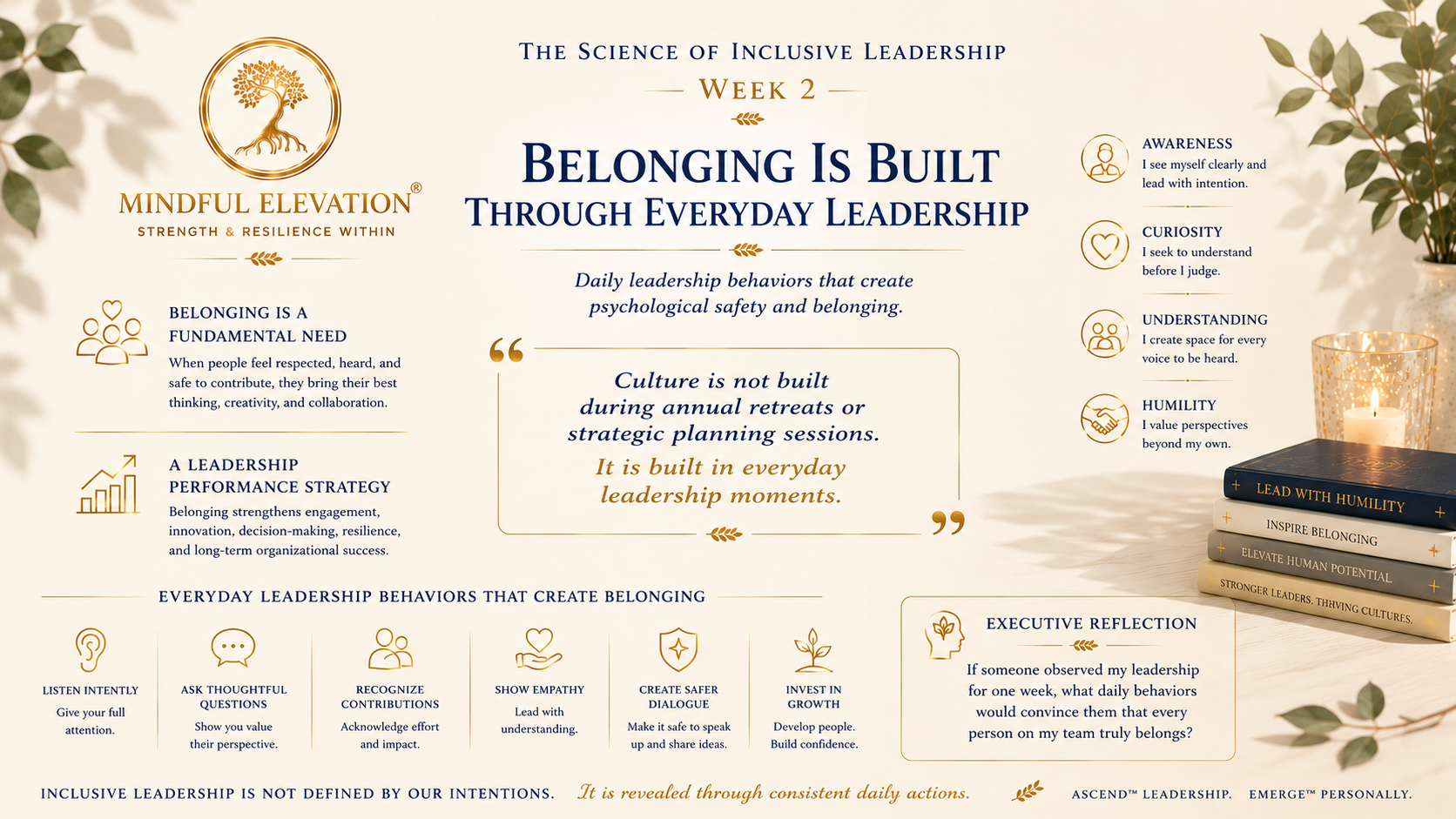
Belonging Is Built Through Everyday Leadership
Belonging is not a program or an initiative. It is the cumulative result of thousands of small leadership choices — who gets heard, who gets developed, who gets the benefit of the doubt, and who does not.
Every leader has blind spots. The question is not whether they exist, but whether the leader is willing to acknowledge, examine, and expand their field of vision.
Cultural blind spots are the assumptions, biases, and gaps in understanding that shape how leaders perceive and respond to people who are different from them. They are not always the product of malice or indifference. They are often the natural result of limited exposure, of having lived and worked primarily within a particular cultural context and having internalized that context as the default.
Leaders who want to build genuine belonging need to examine their everyday practices with honesty. Not just their intentions, but their impact. Not just what they believe about inclusion, but what their behavior actually communicates. Because belonging is not determined by what leaders say they value. It is determined by what people experience.
This requires a particular kind of attention — the willingness to notice who is consistently left out of conversations, who is consistently overlooked for opportunities, who is consistently required to work harder to be taken seriously. And then to do something about it.
Addressing cultural blind spots requires more than awareness. It requires the structural conditions that make honest feedback possible, the psychological safety for people to name what they experience, and the leadership humility to receive that feedback without defensiveness. It requires examining not just individual behavior but organizational systems: hiring processes, performance evaluation criteria, meeting norms, and the informal networks through which opportunity flows.
The leaders who do this work, who are willing to examine their blind spots with honesty and act on what they find, build organizations that are more equitable, more innovative, and more capable of retaining the full range of talent they need to perform. The ones who do not pay a cost that is hidden only until it is not.

Jacqueline Nelms, DHSc
Healthcare executive, behavioral scientist, and founder of Mindful Elevation® — exploring how people and organizations sustain exceptional performance.
About JacquelineMore from the Library
View all articlesThe Invisible Employee Experience: What Leaders Miss When They Only Measure Engagement
Engagement scores tell you whether people are showing up. They do not tell you what it costs them to do so. The most important parts of the employee experience are often the ones that never make it onto a survey.
Read article Inclusive LeadershipPsychologically Safe Leadership: What It Actually Takes to Build Trust
Psychological safety is one of the most cited concepts in organizational research. It is also one of the most misunderstood. It is not about being nice. It is about creating the conditions where honest, courageous work is possible.
Read article Inclusive LeadershipThe Hidden Cost of Cultural Blind Spots in Leadership
Every leader has blind spots. The ones that are most costly are the cultural ones — the assumptions about how people work, what they need, and what good leadership looks like that go unexamined because they feel like common sense.
Read article