
Trauma-Informed Leadership Is Not About Trauma — It's About Human Potential
When leaders hear the phrase 'trauma-informed,' they often assume it means therapy or crisis intervention. It doesn't. It means understanding how human beings actually work — and leading in a way that makes people's best thinking and best work possible.
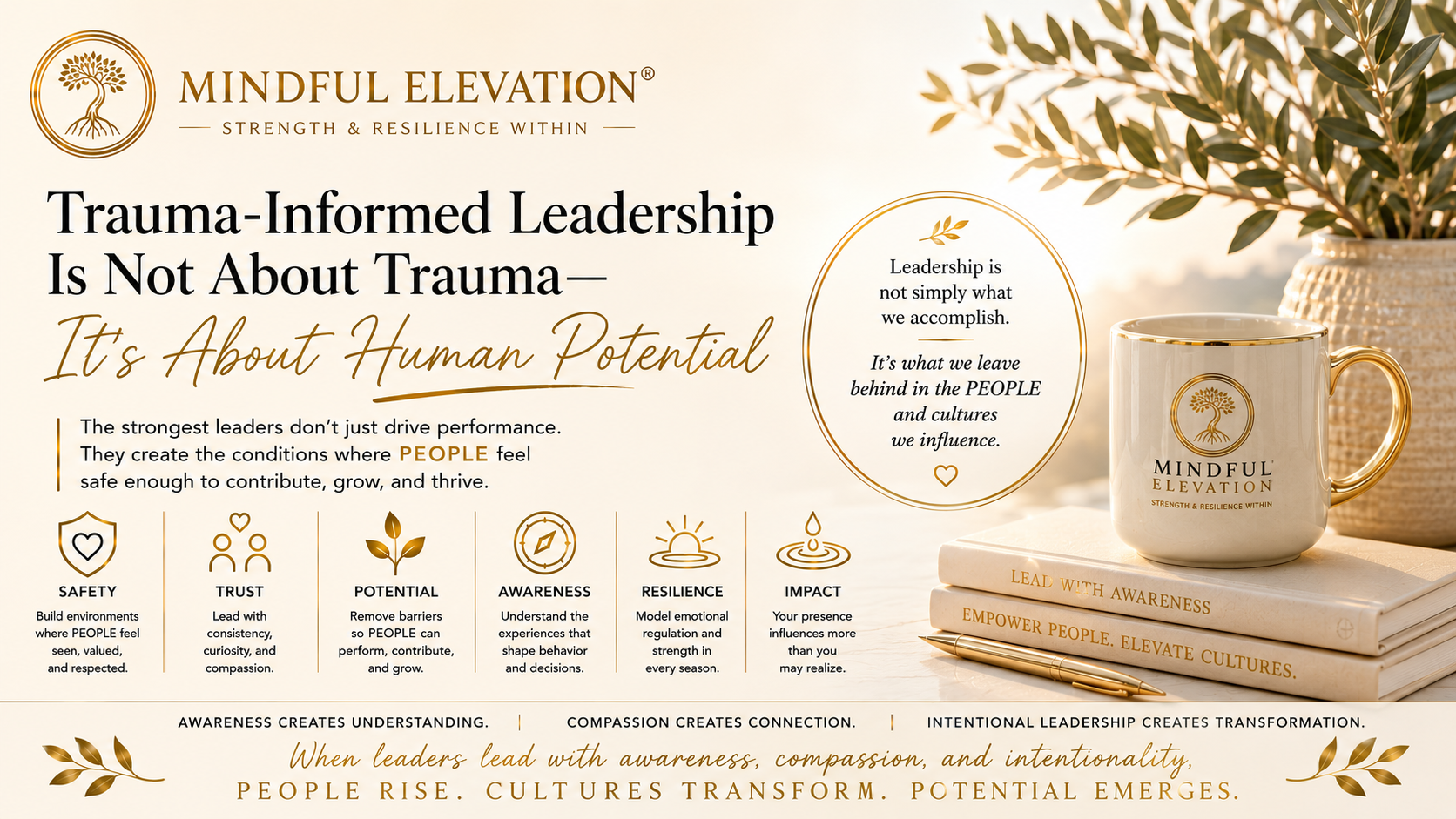
The phrase 'trauma-informed leadership' makes some leaders uncomfortable. It sounds clinical. It sounds like it belongs in a counselor's office, not a boardroom. But that discomfort is based on a misunderstanding of what trauma-informed actually means — and what it has to do with leadership.
Trauma-informed leadership is not about diagnosing your team members or becoming their therapist. It is about understanding how human beings respond to stress, threat, and uncertainty — and leading in ways that work with those responses rather than against them.
The nervous system does not distinguish between a physical threat and a psychological one. When people feel unsafe — when they fear judgment, humiliation, or retaliation — their capacity for complex thinking, creativity, and collaboration is significantly diminished. This is not a character flaw. It is biology. And it has profound implications for how leaders create the conditions for high performance.
A trauma-informed leader understands that psychological safety is not a nice-to-have. It is the neurological prerequisite for the kind of thinking and collaboration that organizations need to thrive. When people feel safe, they can access their full cognitive and creative capacity. When they do not, they cannot — regardless of their skill level or their commitment.
This reframe shifts the question from 'what is wrong with this person?' to 'what does this person need to do their best work?' It shifts the leader's role from evaluator to environment-builder. And it opens up a fundamentally different approach to performance, development, and culture.
Trauma-informed leadership is, at its core, about human potential. It is about creating the conditions in which people can bring their full selves to their work — not in spite of their humanity, but because of it. That is not a soft leadership practice. It is one of the most strategically important investments a leader can make.

Jacqueline Nelms, DHSc
Healthcare executive, behavioral scientist, and founder of Mindful Elevation® — exploring how people and organizations sustain exceptional performance.
About JacquelineMore from the Library
View all articlesThe Leader as Regulator: How Your Nervous System Shapes Your Team's Culture
Your team is not just watching what you say. They are reading your nervous system. The emotional state you bring into the room shapes the emotional state of everyone in it — and that has everything to do with the culture you are building.
Read article Trauma-Informed LeadershipTrauma-Informed Leadership: Building Organizations Where People Can Actually Thrive
Trauma-informed leadership is not a clinical framework imported into the workplace. It is a fundamentally different way of understanding what people need to do their best work — and what leaders need to do to create those conditions.
Read article Self-AwarenessThe Leadership Mirror: What Your Team's Behavior Is Really Telling You
Before you diagnose your team, look in the mirror. The patterns you see in your people are often a direct reflection of the culture you have created — whether you intended to or not.
Read article